.png)
The Diagnostic Trap of Monoclonal Gammopathy of Renal Significance (MGRS): A Kidney First Approach


I have often seen patients with chronic kidney disease who have an abnormal serum protein electrophoresis (SPEP) or free light chain (FLC) ratio and are referred to hematology before a nephrology evaluation. Many undergo an extensive hematologic workup, including a bone marrow biopsy, before their kidney disease is assessed. If the biopsy is negative for multiple myeloma or other hematologic malignancy, the abnormal monoclonal studies are attributed to monoclonal gammopathy of undetermined significance or MGUS ( defined by a serum monoclonal (M) protein spike < 3g/dl or <10% monoclonal plasma cells in the bone marrow, and absence of organ damage from the monoclonal protein). This hematology-first approach was the standard of care about a decade ago, yet it remains widespread.
However, over the last decade, it has become increasingly clear that even small clonal proliferations can produce monoclonal immunoglobulins that cause significant kidney injury (1). This led to recognition of monoclonal gammopathy of renal significance (MGRS). In fact, up to 5-10% of patients previously classified as MGUS fall into this category, and about 40% of patients with monoclonal gammopathies who undergo kidney biopsy have MGRS-related kidney disease (2).
In 2017, the International Kidney and Monoclonal Gammopathy Research Group (IKMG) revised the definition of MGRS to include all B-cell or plasma cell proliferative disorders that produce a monoclonal immunoglobulin capable of causing kidney injury but do not result in significant tumor burden or meet criteria for hematologic malignancy (1,3) (Figure 1). Importantly, these renal lesions do not respond to conventional immunosuppressive therapies used to treat other glomerular disorders, carry a high risk of progression to ESRD, and recur in 70–90% of cases after kidney transplantation (4)

Diagnosis of MGRS requires a kidney biopsy. Observational studies have identified features linked to a higher likelihood of MGRS, including proteinuria >1g /day, abnormal renally adjusted serum FLC ratio, and hematuria. MGRS should be considered in any patient with unexplained AKI or CKD with hematuria and/or proteinuria, even if a monoclonal protein is not easily detectable in serum or urine (5). The Mayo Clinic has developed a risk prediction tool to identify patients most likely to benefit from a kidney biopsy in this setting. A 10% threshold has a very high sensitivity (98.9%) but modest specificity (50.5%), while a 25% threshold offers 88.0% sensitivity and 70.2% specificity (6).
The presence or absence of monoclonal immunoglobulin deposits on a kidney biopsy classifies renal abnormalities in MGRS (Figure 2). These lesions are further divided into organized or unorganized deposits based on electron microscopy. Organized deposits are classified as fibrillar, microtubular, inclusions, or crystals. In MGRS, kidney injury is caused not by tumor burden but by the intrinsic nephrotoxicity of monoclonal immunoglobulins or their fragments. These proteins can misfold and aggregate (AL-amyloidosis), deposit along glomerular or tubular basement membranes, form intracellular crystals in proximal tubules (LCPT), or organize into microtubular (immunotactoid glomerulopathy) or cryoglobulin deposits (cryoGN). Monoclonal immunoglobulins may also activate complement pathways (thrombotic microangiopathy) or act as autoantibodies against renal targets (C3GN), triggering inflammation and progressive kidney damage even at low circulating levels (7) (see here).

Once MGRS is diagnosed, appropriate clone-directed therapy requires a hematologist's evaluation, bone marrow biopsy, and studies such as flow cytometry, FISH analysis, and immunohistochemistry to identify the clone. An important feature of a kidney biopsy is matching the specific immunoglobulin found in the biopsy with that found during hematological investigation. Treating the underlying clonal abnormality and achieving hematologic remission is essential because the risk of recurrence after kidney transplantation is high without treatment (8).
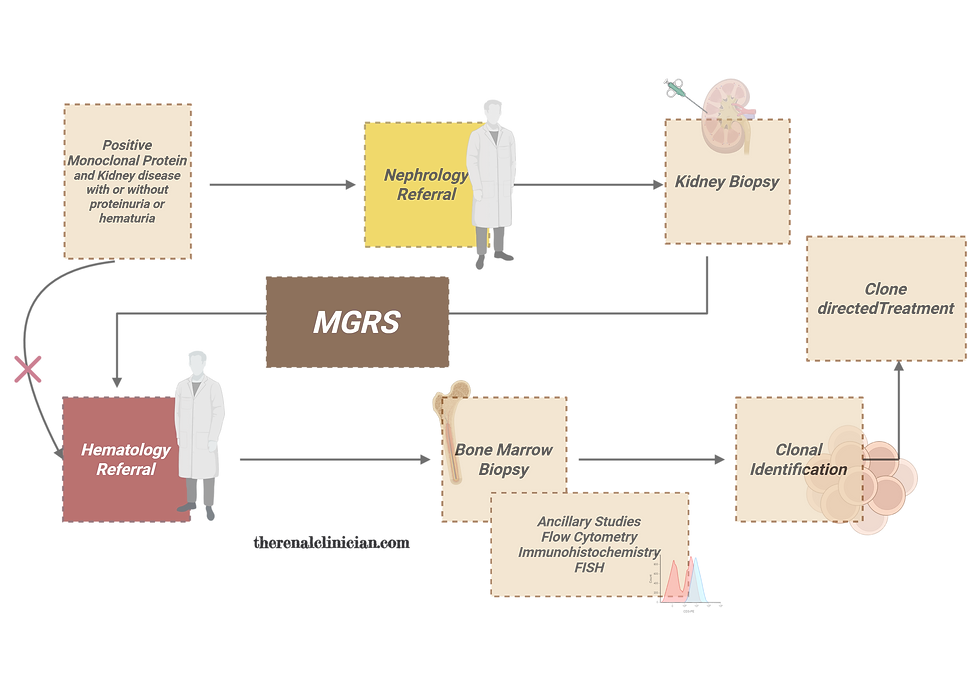
Therefore, clone-directed therapy should be initiated in all patients with biopsy-proven MGRS who have evidence of kidney damage attributable to the monoclonal protein, regardless of tumor burden. For transplant candidates, therapy is indicated to prevent recurrence after transplantation. For patients who are not candidates for transplantation, treatment is recommended only if there is progressive kidney dysfunction or extrarenal organ involvement, or if the criteria for a malignant process are met (9).
In patients with monoclonal gammopathies and any renal involvement, nephrology evaluation and kidney biopsy should precede hematologic classification, as delaying therapy risks irreversible kidney failure even in the absence of overt hematologic malignancy.
References:
Leung, N.; Bridoux, F.; Batuman, V.; Chaidos, A.; Cockwell, P.; D’Agati, V. D.; Dispenzieri, A.; Fervenza, F. C.; Fermand, J.-P.; Gibbs, S.; Gillmore, J. D.; Herrera, G. A.; Jaccard, A.; Jevremovic, D.; Kastritis, E.; Kukreti, V.; Kyle, R. A.; Lachmann, H. J.; Larsen, C. P.; Ludwig, H.; Markowitz, G. S.; Merlini, G.; Mollee, P.; Picken, M. M.; Rajkumar, V. S.; Royal, V.; Sanders, P. W.; Sethi, S.; Venner, C. P.; Voorhees, P. M.; Wechalekar, A. D.; Weiss, B. M.; Nasr, S. H. The Evaluation of Monoclonal Gammopathy of Renal Significance: A Consensus Report of the International Kidney and Monoclonal Gammopathy Research Group. Nat. Rev. Nephrol. 2019, 15 (1), 45–59.
Bridoux, F.; Nasr, S. H.; Arnulf, B.; Leung, N.; Sirac, C.; Jaccard, A. Renal Manifestations of MGUS. Hematology Am. Soc. Hematol. Educ. Program 2024, 2024 (1), 489–498.
A.; Fervenza, F. C.; Fermand, J.-P.; Gibbs, S.; Gillmore, J. D.; Herrera, G. A.; Jaccard, A.; Jevremovic, D.; Kastritis, E.; Kukreti, V.; Kyle, R. A.; Lachmann, H. J.; Larsen, C. P.; Ludwig, H.; Markowitz, G. S.; Merlini, G.; Mollee, P.; Picken, M. M.; Rajkumar, V. S.; Royal, V.; Sanders, P. W.; Sethi, S.; Venner, C. P.; Voorhees, P. M.; Wechalekar, A. D.; Weiss, B. M.; Nasr, S. H. The Evaluation of Monoclonal Gammopathy of Renal Significance: A Consensus Report of the International Kidney and Monoclonal Gammopathy Research Group. Nat. Rev. Nephrol. 2019, 15 (1), 45–59.
Pinney, J.; Roufosse, C.; Kousios, A.; Chaidos, A.; Gillmore, J. D.; Rainone, F.; Choudhuri, S.; Ramasamy, K.; Blakey, S.; Ashcroft, J.; Chan, Y. L. T.; Cockwell, P.; Pratt, G.; BSH Committee. Diagnosis and Management of Monoclonal Gammopathy of Renal Significance: A British Society for Haematology Good Practice Paper. Br. J. Haematol. 2025, 206 (2), 447–463.
Bridoux, F.; Leung, N.; Hutchison, C. A.; Touchard, G.; Sethi, S.; Fermand, J.-P.; Picken, M. M.; Herrera, G. A.; Kastritis, E.; Merlini, G.; Roussel, M.; Fervenza, F. C.; Dispenzieri, A.; Kyle, R. A.; Nasr, S. H.; International Kidney and Monoclonal Gammopathy Research Group. Diagnosis of Monoclonal Gammopathy of Renal Significance. Kidney Int. 2015, 87 (4), 698–711.
Klomjit, N.; Evans, M. D.; Vargas, M.; Marka, N.; Fervenza, F. C.; Sethi, S.; Zand, L. The Mayo MGRS Prediction Tool Calculates the Risk of Finding Monoclonal Gammopathy of Renal Significance in a Kidney Biopsy in Patients with Monoclonal Gammopathy. Kidney Int. 2025, 108 (2), 271–282
Leung, N.; Bridoux, F.; Nasr, S. H. Monoclonal Gammopathy of Renal Significance. N. Engl. J. Med. 2021, 384 (20), 1931–1941.
Netti, G. S.; Troise, D.; Rossini, M.; Catalano, V.; De Luca, F.; Khalid, J.; Camporeale, V.; Ritrovato, F.; Infante, B.; Sanguedolce, F.; Stallone, G.; Ranieri, E. Diagnostic and Therapeutic Aspects of Monoclonal Gammopathies of Renal Significance (MGRS): An Update. Diagnostics (Basel) 2024, 14 (24), 2892.
Leung, N.; Bridoux, F.; Batuman, V.; Chaidos, A.; Cockwell, P.; D’Agati, V. D.; Dispenzieri, A.; Fervenza, F. C.; Fermand, J.-P.; Gibbs, S.; Gillmore, J. D.; Herrera, G. A.; Jaccard, A.; Jevremovic, D.; Kastritis, E.; Kukreti, V.; Kyle, R. A.; Lachmann, H. J.; Larsen, C. P.; Ludwig, H.; Markowitz, G. S.; Merlini, G.; Mollee, P.; Picken, M. M.; Rajkumar, V. S.; Royal, V.; Sanders, P. W.; Sethi, S.; Venner, C. P.; Voorhees, P. M.; Wechalekar, A. D.; Weiss, B. M.; Nasr, S. H. The Evaluation of Monoclonal Gammopathy of Renal Significance: A Consensus Report of the International Kidney and Monoclonal Gammopathy Research Group. Nat. Rev. Nephrol. 2019, 15 (1), 45–59


Comments